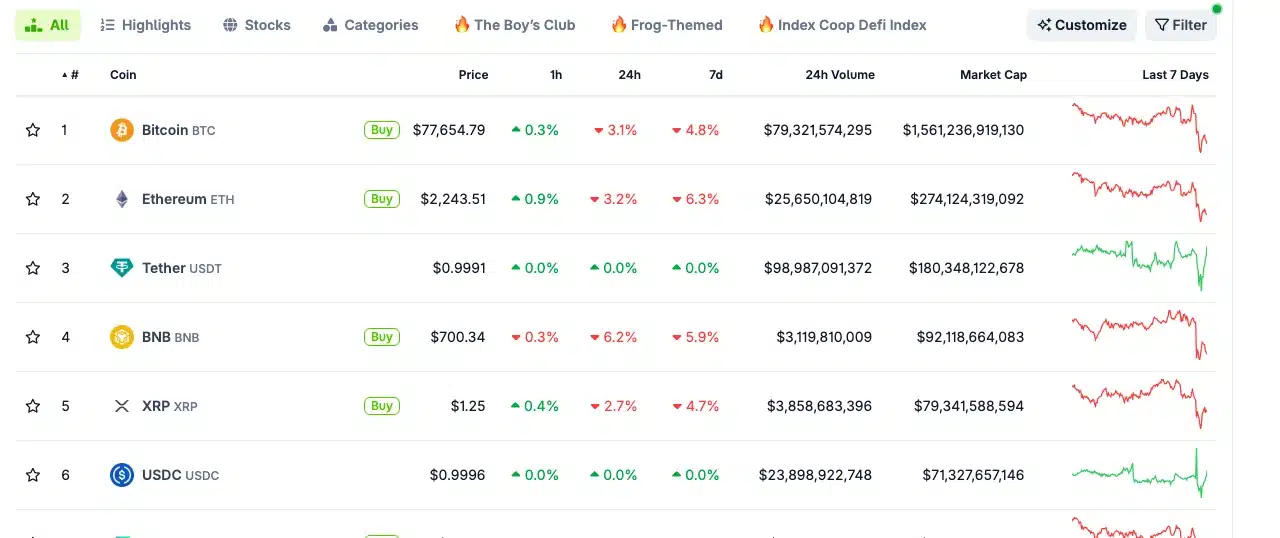
The best cryptocurrencies to invest in for most people are still Bitcoin and Ethereum, with a smaller slice in large, liquid altcoins such as Solana, XRP and BNB. Everything further down the list is a higher-risk bet. Prices below are from CoinGecko on October 30, 2026.
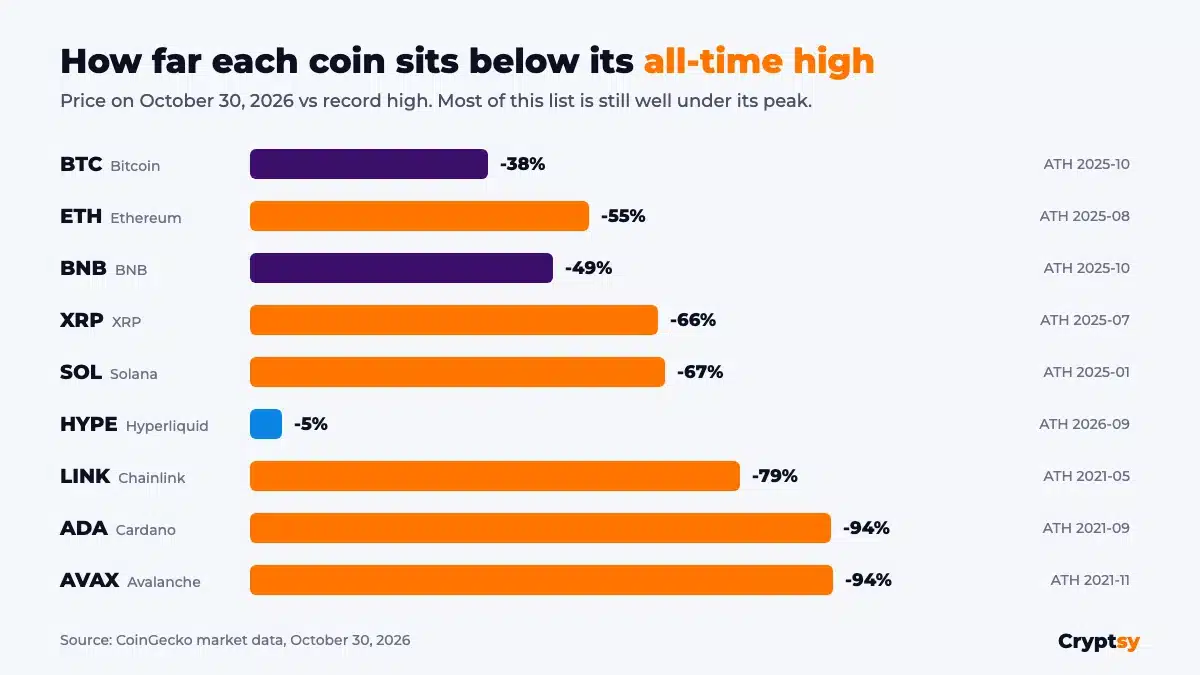
One number frames the whole market right now: Bitcoin is about 38% below its October 2025 record and down 29% over twelve months. Most altcoins have fallen further.
This is not financial advice. Crypto can lose most of its value quickly. Only invest money you can afford to lose.
Key takeaways
- Bitcoin ($77,668) and Ethereum ($2,244) make up the core. Bitcoin alone is 60% of the whole crypto market by value.
- Large caps (BNB, XRP, Solana, TRON) add more upside and more risk.
- Higher-risk picks (Hyperliquid, Chainlink, Cardano, Avalanche) can move 50% or more in a month, up or down.
- Eight of the ten coins below are lower than a year ago. The exceptions are TRON (+15%) and Hyperliquid (+93%).
- Buy on a regulated exchange, then move long-term holdings to a wallet you control.
The 10 cryptocurrencies at a glance
| Coin | Risk tier | Price | Market cap | Rank | 1 year | From all-time high |
|---|---|---|---|---|---|---|
| Bitcoin (BTC) | Core | $77,668 | $1,562B | #1 | -29% | -38% |
| Ethereum (ETH) | Core | $2,244 | $274B | #2 | -42% | -55% |
| BNB (BNB) | Large cap | $701 | $92B | #4 | -37% | -49% |
| XRP (XRP) | Large cap | $1.25 | $79B | #5 | -51% | -66% |
| Solana (SOL) | Large cap | $96.87 | $57B | #7 | -50% | -67% |
| TRON (TRX) | Large cap | $0.340 | $32B | #8 | +15% | -21% |
| Hyperliquid (HYPE) | Higher risk | $92.92 | $22B | #10 | +93% | -5% |
| Chainlink (LINK) | Higher risk | $11.09 | $8.5B | #17 | -38% | -79% |
| Cardano (ADA) | Higher risk | $0.194 | $7.3B | #18 | -69% | -94% |
| Avalanche (AVAX) | Higher risk | $8.57 | $3.8B | #29 | -56% | -94% |
Core holdings: Bitcoin and Ethereum
1. Bitcoin (BTC): $77,668
Bitcoin is the default first position for a reason. Supply is capped at 21 million coins, and the April 2024 halving cut new issuance to 3.125 BTC per block. US spot Bitcoin ETFs have traded since January 2024, so the same asset you buy on an exchange is held by funds and public companies.
The case for buying now is simple: it is about 38% below its October 2025 high of $126,080. The case against is that it has been lower over the past year, and nothing guarantees it returns to the record.
2. Ethereum (ETH): $2,244
Ethereum is the largest smart-contract network, home to most DeFi activity and a big share of stablecoin settlement. US spot Ether ETFs launched in July 2024. You can also stake ETH for a yield on top of price exposure, although liquid staking rates are low single digits.
ETH has had a harder year than Bitcoin, down 42%, and sits 55% under its August 2025 peak. Some investors see that gap as value. Others see a network losing activity to cheaper chains.
Large caps: more upside, more risk
3. BNB (BNB): $701
BNB powers BNB Chain and gives fee discounts on Binance. Its value is tied closely to Binance’s business. US residents cannot use the main Binance exchange; Binance.US is a separate company and is not available in every state.
4. XRP (XRP): $1.25
XRP is built for fast payments, settling in seconds for a fraction of a cent. Ripple’s long legal fight with the SEC ended in 2025, and the company also issues the RLUSD stablecoin. XRP is still 66% below its July 2025 high and down 51% over the year, so the market has not yet rewarded the legal win.
5. Solana (SOL): $96.87
Solana is the busiest high-speed chain for trading and consumer apps, with very low fees. It is also one of the most volatile large caps: down 19% in the past 30 days, down 50% over the year and 67% from its January 2025 record.
6. TRON (TRX): $0.340
TRON is the least exciting coin on this list and that is partly the point. It carries more USDT than any other blockchain, which makes it core plumbing for stablecoin payments. TRX is up 15% over twelve months, far steadier than most large caps.
Higher-risk picks
7. Hyperliquid (HYPE): $92.92
Hyperliquid runs one of the largest on-chain exchanges for perpetual futures, and the protocol uses trading fees to buy back HYPE. It is the best performer here over the year (+93%), and it set a new high in September 2026. That strength is also the risk: a coin near its peak has further to fall, and its value depends on one exchange keeping its users.
8. Chainlink (LINK): $11.09
Chainlink supplies price feeds and cross-chain messaging to a large share of DeFi apps. The technology is widely used, but the token still trades 79% below its 2021 high.
9. Cardano (ADA): $0.194
Cardano has a loyal community and a research-led approach, but adoption has lagged. ADA is 94% below its 2021 high and down 69% in a year. Buying it today is mostly a recovery bet.
10. Avalanche (AVAX): $8.57
Avalanche lets companies and projects launch their own custom chains. Like Cardano, it is 94% below its 2021 peak, and it lost another 23% in the past month. Big swings in both directions are normal at this size.
Coins that dropped off this list since our earlier version: Polygon (now #74), Arbitrum (#70) and Polkadot (#57) are down 53%, 47% and 69% over the year. For a wider look at the altcoin market, see our top 10 altcoins right now.
Crypto market capitalization in 2026: where the money sits
Market capitalization is the price of a coin multiplied by the number of coins in circulation. It is the quickest way to see how big a project really is, and it is how CoinGecko and CoinMarketCap rank every coin they track.
On October 30, 2026, CoinGecko put the value of all cryptocurrencies at about $2.61 trillion, spread across more than 22,000 active coins and 1,520 trading venues. Around $172 billion changed hands in the previous 24 hours. That sounds spread out, but the money is not. Bitcoin alone was 59.8% of the total, and the top nine assets held roughly 91%.
| Asset | Share of total crypto market cap | Market cap (Oct 30, 2026) |
|---|---|---|
| Bitcoin (BTC) | 59.8% | $1.56 trillion |
| Ethereum (ETH) | 10.5% | $274 billion |
| Tether (USDT) | 6.9% | $180 billion |
| BNB | 3.5% | $92 billion |
| XRP | 3.0% | $79 billion |
| USD Coin (USDC) | 2.7% | $71 billion |
| Solana (SOL) | 2.2% | $57 billion |
| TRON (TRX) | 1.2% | $32 billion |
| Hyperliquid (HYPE) | 0.9% | $22 billion |
Two of those nine are stablecoins pegged to the US dollar, so they hold their value rather than grow it. Leave them out and the investable top of the market is even more concentrated.
Why it matters for your money: a bigger market cap usually means deeper liquidity. You can buy or sell a few thousand dollars of Bitcoin without moving the price at all. Try the same with a coin worth $50 million in total and the price can jump or slip several percent on your order alone. Market cap also tells you how much new money a coin needs to double. Bitcoin needs another $1.5 trillion. A small coin might need only a few million, which is why small caps swing so hard in both directions.
One caution: a low price per coin does not mean a coin is cheap. Cardano at $0.19 has a market cap of $7.3 billion. What counts is the total value and the share of supply still to be released, not the number on the ticker.
Why institutional investors matter for crypto prices
For most of its history, crypto was driven by retail traders and early enthusiasts. That changed step by step as large institutions got regulated ways in, and each step brought new liquidity and new buyers who rarely sell on a bad week.
- December 2017: the Chicago Mercantile Exchange (CME) launched cash-settled Bitcoin futures, giving funds a regulated way to hedge or bet on the price.
- August 2023: a US appeals court ruled that the Securities and Exchange Commission had been wrong to reject Grayscale’s plan to turn its Bitcoin trust into a spot fund.
- January 2024: the Securities and Exchange Commission approved the first US spot Bitcoin ETFs, opening the door for pension funds, advisers and retirement accounts.
- July 2024: spot Ether funds followed, and spot Solana and XRP funds launched in late 2025.
- July 2025: the GENIUS Act became law, the first US federal framework for dollar stablecoins, which brought banks and payment firms closer to crypto rails.
The result is a market where traditional finance now owns a real slice of the supply. Funds, public companies and banks move slower than retail traders, which can soften the worst selloffs, but they also tie crypto more closely to the wider economy. When interest rates, tech stocks or risk appetite turn, Bitcoin now tends to move with them.
For an individual investor, the practical point is simple. Coins with institutional access through regulated funds, futures and bank custody have a broader base of buyers. That is one reason this list leans so heavily on Bitcoin and Ethereum and keeps the small caps small.
Utility and adoption: what each crypto asset is actually used for
Price follows usage over the long run. A token that people need in order to use an application has demand that does not depend only on speculation. Here is what each coin on this list does, and how holders can earn a reward on top of price moves.
| Coin | Main use | Built-in reward for holders |
|---|---|---|
| Bitcoin | Store of value and payments; the Lightning Network handles small, fast transfers | None at the protocol level |
| Ethereum | Smart contracts that run DeFi, stablecoins, NFTs and most layer 2 networks | Staking yield for validators |
| BNB | Pays network fees on BNB Chain and gives fee discounts on Binance | Staking on BNB Chain |
| XRP | Cross-border settlement on the XRP Ledger, live since 2012 | None at the protocol level |
| Solana | High-speed transactions for trading apps, payments and consumer apps | Staking yield |
| TRON | A major rail for USDT stablecoin transfers | Staking and voting rewards |
| Hyperliquid | Its own on-chain trading venue for perpetual futures | Most trading fees fund HYPE buybacks |
| Chainlink | Oracles that feed real-world prices and data into smart contracts | Staking for node operators and holders |
| Cardano | Proof-of-stake smart contract network built from peer-reviewed research | Staking yield |
| Avalanche | A network of custom blockchains (L1s) for apps and institutions | Staking yield |
Signs of real traction are easy to check for free. Look at the fees a network collects, the number of active addresses, the value of stablecoins on it and the amount locked in its decentralized finance apps. Sites like DefiLlama publish these figures daily. A coin whose usage is growing while its price falls is a very different bet from one where both are shrinking.
Adoption of crypto in banking and payments is still early. Most of the activity today is trading, stablecoin transfers and DeFi. That is a solution to real problems, such as slow and costly international transfers, but it also means token values still depend heavily on market mood.
Are any of these cryptocurrencies undervalued?
A coin that has fallen a long way can look attractive, and several picks here sit far below their records. Avalanche is 94% below its high, Cardano 94% and Chainlink 79%. Bitcoin is down 38%.
Distance from a peak is not the same as being undervalued. A coin can fall 90% and keep falling if usage dries up or new supply keeps hitting the market. Before calling anything undervalued, compare its price trend with its usage trend:
- Are fees and active users rising or falling over the last quarter?
- Is a large percentage of the supply still locked and waiting to be released?
- Is there an upcoming update or announcement the market has not priced in, or is the story already old?
- Would you still hold it if it dropped another 50%?
If the answers point the right way, a deep drawdown can be a reasonable entry for a small position. If they do not, a low price is just a low price.
How to build a position without overthinking it
- Start with the core. Many investors put most of a crypto allocation in Bitcoin and Ethereum and treat everything else as satellite bets.
- Size each bet so a 90% drop would not hurt you. Cardano and Avalanche show that large, well-known coins can lose that much.
- Buy in stages. Regular fixed purchases (dollar-cost averaging) remove the pressure of picking the bottom.
- Ignore anything that promises returns. Presales and “guaranteed” yields are where most retail losses happen.
Where to buy and how to store it
Use a regulated exchange that serves your state, and check the real fee before you trade. For example, Kraken’s published spot fee for accounts trading under $2,500 a month is 0.40% for makers and 0.80% for takers, falling as volume rises. Simple “buy” buttons in exchange apps usually cost more than the advanced trading screen. Our low-fee exchange comparison covers the main options.
Anything you plan to hold for years belongs in a wallet you control, not on the exchange. Our Bitcoin cold storage guide explains hardware wallets and seed backups step by step.
How to invest in cryptocurrency: step by step
If you have never bought cryptocurrencies before, the process takes about an hour, most of it spent on identity checks. These are the steps most US investors follow:
- Pick a regulated exchange or brokerage platform that serves your state. Coinbase and Kraken are two of the largest US crypto exchanges, and some stock brokerages also sell Bitcoin and Ethereum.
- Verify your identity. US platforms are required to check ID before you can buy, so have a driver’s license or passport ready.
- Fund the account in US dollars or another fiat currency by bank transfer. Card purchases are faster but usually cost more.
- Buy your core position first, usually Bitcoin (BTC) and Ethereum (ETH), then add smaller amounts of the altcoins you have researched.
- Set up recurring buys if you plan to invest a fixed amount every week or month.
- Move long-term holdings to your own wallet and write down the recovery phrase on paper or steel.
- Keep records of every transaction: each purchase, sale and swap matters at tax time.
What makes a cryptocurrency worth investing in?
CoinGecko tracks more than 22,000 coins, but value is concentrated at the top. On October 30, 2026, Bitcoin was about 60% of the whole crypto market and Ethereum about 11%. Most other cryptocurrencies share what is left of the market. Before you invest in any coin outside that pair, check five things:
- Market cap and trading volume. Large, liquid coins are easier to buy and sell without moving the price. A tiny coin can be hard to exit when the market turns.
- What the token is used for. Paying transaction fees (ETH, SOL, TRX), settling cross-border payments (XRP), securing decentralized finance apps (LINK) or sharing protocol revenue (HYPE) gives a token demand from real users, not just speculation.
- Supply and unlocks. Check the maximum supply and how many tokens are still to be released. Large unlocks for early investors can push the price down.
- Track record. Coins that have survived several market cycles, outages and legal fights have shown they can last. Newer coins have not.
- Where you can trade it. If a coin is only listed on small offshore exchanges or a few decentralized exchanges, that is a warning sign for US investors.
Blockchain technology on its own is not a reason to buy. Plenty of cryptocurrencies run on working technology and still lost most of their market value, as the 2021 high points in the table above show. The investor question is whether the token captures value when the network is used.
Crypto ETFs and crypto stocks: investing without holding coins
You do not have to hold coins directly to get crypto exposure. US spot Bitcoin ETFs have traded since January 2024 and spot Ether ETFs since July 2024, so investors can buy them in an ordinary brokerage or retirement account like any stock. That brought Bitcoin into traditional finance. You pay an annual fund fee instead of exchange trading fees, and you never manage a wallet or recovery phrase.
Crypto-linked stocks are another route. Coinbase (COIN) has been listed on Nasdaq since April 2021, and some public companies hold Bitcoin on their balance sheets. These stocks tend to move with the crypto market, often more sharply, and also carry ordinary business risk. An ETF tracks the coin. A stock tracks a company.
| Route | What you own | Costs | Best for |
|---|---|---|---|
| Buy coins on an exchange | The cryptocurrency itself | Trading fees, spread | Investors who want to self-custody or use crypto |
| Spot Bitcoin or Ether ETF | Fund shares that hold the coin | Annual fund fee | Brokerage and retirement accounts |
| Crypto stocks | Shares in a company | Stock trading costs | Investors comfortable with business risk on top of crypto risk |
Crypto stocks to buy if you would rather own shares
If you prefer the stock market, a handful of listed companies give crypto exposure through a normal brokerage account. They are not the same as owning coins, and each one carries its own business risk.
- Coinbase (COIN): the largest US crypto trading platform, listed on Nasdaq since April 2021 and added to the S&P 500 in May 2025. Its revenue rises and falls with trading volume.
- Strategy (MSTR): the company formerly called MicroStrategy, which holds a large Bitcoin treasury funded by issuing shares and debt. It tends to move like a leveraged version of Bitcoin.
- Robinhood (HOOD): a retail brokerage with a growing crypto business, added to the S&P 500 in September 2025.
- Bitcoin miners: companies such as Cipher Mining (CIFR) earn Bitcoin from mining and have signed long-term deals to lease data center space for AI computing, the same kind of demand that drove Nvidia’s growth.
Crypto stocks often swing more than the coins themselves, because company results, debt and share issuance pile extra risk on top of the crypto price. If you want Bitcoin exposure in a stock account with the fewest moving parts, a spot ETF tracks the coin more closely than any single company.
Cryptocurrencies to avoid
- Coins pushed by influencers or paid ads promising a 10x or 100x return.
- Presales and new token launches with no trading history and large allocations held by insiders.
- Memecoins you cannot explain. Most memecoin tokens have no payment or finance use. Dogecoin is the exception that lasted, and even it trades about 90% below its 2021 high.
- Anything offered on an unlicensed platform or through a stranger who contacted you first. Investment scams often start with a friendly message and ask users to pay in a digital currency that cannot be reversed.
Litecoin and Bitcoin Cash: why older coins missed the list
Two names that used to sit near the top of every ranking are missing here. Both still work as payment networks, but the numbers no longer earn them a place.
Litecoin (LTC) launched in 2011 as a faster, lighter version of Bitcoin. On October 30, 2026 it traded at $55.53, ranked 25th by market cap at about $4.3 billion, down 43% over a year and 86% below its all-time high. It has a long record and broad acceptance at payment processors, but little new usage to drive demand.
Bitcoin Cash (BCH) split from Bitcoin in August 2017 over block size. It traded at $285 on the same day, ranked 20th at about $5.7 billion, down 50% over a year and 92.5% below its peak. Bigger blocks made payments cheaper, but most users who want cheap Bitcoin payments now use the Lightning Network instead.
Neither is a scam. They are simply older projects that have lost ground to networks with more developers, more apps and more participants.
Taxes
In the US, the IRS treats crypto as property. Selling, swapping one coin for another, or spending crypto can each create a taxable gain or loss. Starting with 2025 transactions, US brokers report crypto sales to the IRS on Form 1099-DA, so keep your own records too. Our crypto tax guide goes deeper.
How we pick and update this list
Every coin on this list is ranked inside its risk tier by market cap, liquidity, real usage and track record. Prices, returns and drawdowns come from CoinGecko’s public data on the date shown at the top of each section. We review the picks at least once a quarter and after any major market event, such as a new fund approval or a large hack, so an outdated pick does not sit here for months.
This is general information for investors and crypto enthusiasts, not personal financial advice. Crypto can lose most of its value quickly, so only put in money you can afford to lose.
Frequently Asked Questions
What is the best cryptocurrency to invest in right now?
For most people, Bitcoin, then Ethereum. Bitcoin is the largest and most widely held crypto asset, priced at $77,668 on October 30, 2026. Smaller coins can rise faster but carry much higher risk.
Is it too late to buy Bitcoin?
Nobody knows the future price. On October 30, 2026 Bitcoin traded about 38% below its October 2025 record and 29% lower than a year earlier, so buyers today pay less than at the peak, but there is no guarantee it recovers.
Which altcoin has done best over the past year?
Of the coins on this list, TRON (+15%) and Hyperliquid (+93%) were up over twelve months as of October 30, 2026. Most of the other large altcoins fell between 35% and 70%.
How much of my portfolio should be in crypto?
There is no single right number. A common rule is to keep crypto to an amount you could lose entirely without changing your life, and to hold most of it in Bitcoin and Ethereum.
Are stablecoins a good investment?
Stablecoins such as USDT and USDC are designed to stay at $1, so they do not grow in value. They are useful for moving money and earning interest, not for price gains.
How do I start investing in cryptocurrency?
Open an account on a regulated US exchange or brokerage, verify your identity, fund it by bank transfer and buy a small amount of Bitcoin or Ethereum first. Move anything you plan to hold for years to a wallet you control.
Is it better to buy a Bitcoin ETF or Bitcoin itself?
An ETF is simpler: it sits in a normal brokerage account and needs no wallet, but you pay an annual fund fee and cannot send the coins. Buying Bitcoin directly lets you hold it yourself and use it, but you are responsible for keeping it safe.
Do I pay tax on crypto gains in the US?
Yes. The IRS treats crypto as property, so selling, swapping or spending it can trigger capital gains tax. Brokers report sales on Form 1099-DA starting with 2025 transactions.
Which cryptocurrency has the highest market capitalization?
Bitcoin, by a wide margin. On October 30, 2026 it was worth about $1.56 trillion, or 59.8% of the total crypto market. Ethereum was second at about $274 billion.
What is the safest cryptocurrency to invest in?
No cryptocurrency is safe in the way a bank deposit is. Bitcoin has the longest record, the most liquidity and the widest institutional access, so it is usually treated as the lowest-risk option, but it has still fallen more than 70% in past downturns.
Is Litecoin still worth buying?
Litecoin still works as a payment network, but on October 30, 2026 it ranked 25th by market cap and was down 43% over a year. It missed this list because newer networks are growing faster in users and apps.